
Retrofit | Heat pumps
An air-source heat pump can heat any home — of any age or construction — as effectively as a gas (or oil) boiler, and at a lower running cost if correctly designed and installed by a competent installer.
The £7,500 Boiler Upgrade Scheme grant for an ‘Air to Water’ system (£9,000 if you're currently on oil or LPG) means the net cost for a typical home after grants and VAT relief is often between £1,500 and £8,500 — and potentially less for a typical house. The grant for an ‘Air to Air’ system which will heat your house without need for plumbing is £2,500, and can be used for cooling also (it’s less because they are cheaper to install).
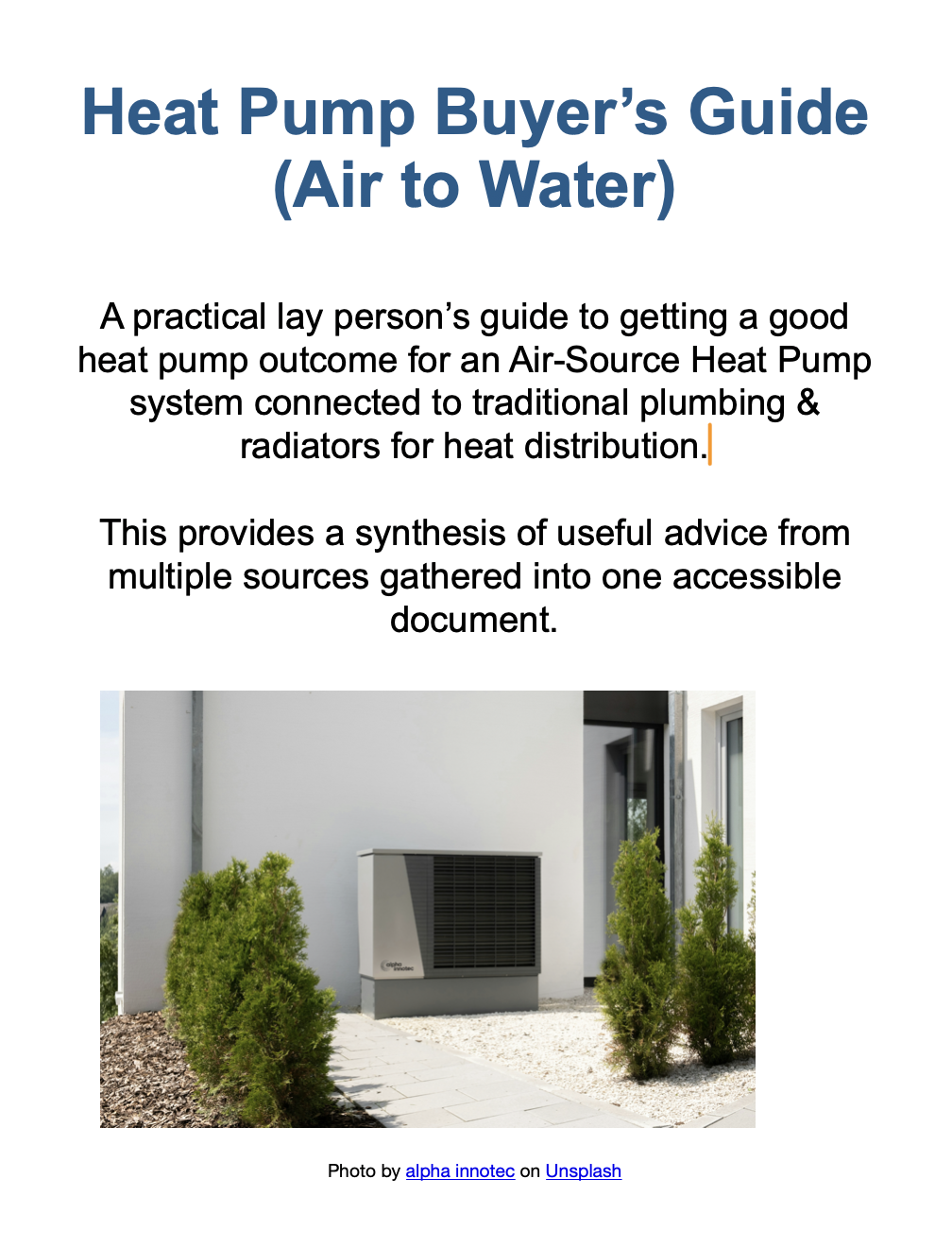
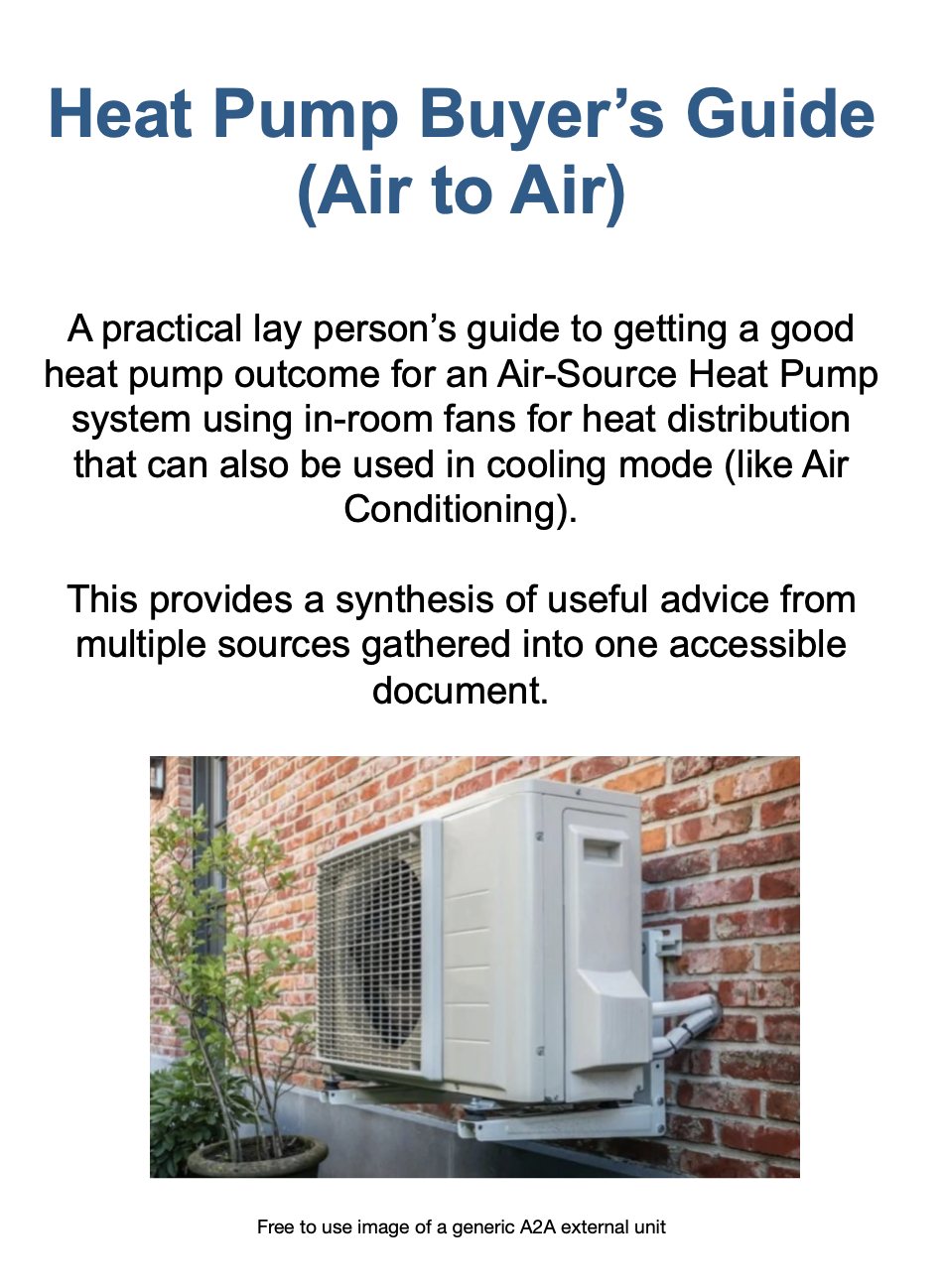
NailsworthCAN has produced Buyer’s Guides for both variants of an Air Source Heat Pump (Air to Water (A2W) and Air to Air (A2A)). We hope this will give you the tools you need to find a competent installer, ask the right questions, spot the red flags, and compare quotes on what actually matters — not just the quoted price (click on each image below in turn to read the guides).

Saving on heating bills with a heat pump - the numbers
There is no type or age of home unsuitable for a heat pump, contrary to a widespread belief. In this short guide we look at how much you’d save on your annual heating bills from a heat pump compared to your old gas or oil boiler. This focuses on comparing running costs:
Saving On Heating Bills With a Heat Pump
Why are they so efficient at heating?
A Heat Pump is based on the principle of heat transfer. Heat transfer uses a small amount of energy to transfer the free and renewable low-grade heat from the air or ground to high-grade heat suitable for space heating in homes (and heating water also with A2W heat oumo)..
Heat pumps are extremely efficient and are a proven technology. For every unit of electricity to run a heat pump, they deliver at least three units of heat (i.e. at least 300% efficient, typically 350-400%). This high efficiency counteracts the high price of electricity in the UK.
And when replacing an old gas boiler, running costs do not need to rise when installing an air-source heat pump, as we explored in How to heat your home with the minimum amount of energy, and save the planet. Installing a heat pump is the single biggest thing a householder can do to reduce the carbon footprint of heating.
Cooling using A2A heat pumps is also very efficient.
Is cooling with a heat pump just a way to avoid better building standards?
It’s more complicated than that. In the Mediterranean homes have been built to deal with hot summers for hundreds of years, and even ancient times. In the UK architects do know how to design new houses that can avoid the need for ‘air conditioning’ to prevent over heating.
However, around four in five of the homes that will be occupied in 2050 have already been built — which is why retrofit matters far more than new build standards alone for decarbonising the UK housing (Climate Change Committee / House of Commons Energy Security and Net Zero Committee, 2024). We can do a lot using shading (especially external shading) and other measures, but given extreme heatwaves that are becoming more common, this will not be sufficient.
Opposition to Air-Conditioning (A/C) has been around for years because it is seen as a fossil-fuel powered sticking plaster to renovation, but there are two factors that need to be considered: Firstly, the costs of the fabric measures needed to completely avoid the need for mechanical cooling can be very high, and secondly, dwellings with their own or community based renewables can power their own energy needs.
However, this new conversation represents a surprising opportunity! If instead of traditional A/C we install Air-to-Air heat pumps capable of cooling and heating, we can solve the issue of decarbonising home energy very efficiently, using the increasingly renewables-based power sector. It’s a win win.
When dwellings and community spaces can use their own local power (typically solar PV on roofs, but also wind turbines), we can also significanly relieve pressure on the grid, and improve energy resilience for communities and the country as a whole.
This is not a reason to not employ passive measures - like tree planting near buildings, shutters, etc. - but is an unavoidable need to protect especially vulnerable people, young and old, in buildings that were not built for our human-induced, rapidly changing climate.
Heat pumps are part of a bigger picture
Heat pumps are part of a wider transition towards electrification of much of our end-use of energy (see The Future Is Electric). For more insight, please go to our piece on Demystifying Heat Pumps.
SIMPLE CALCULATOR Heat pump savings
In a few places we provide numbers giving the savings you can make from switching from a gas (or oil) boiler to a heat pump. For anyone who is proficient in using a spreadsheet, you may like to play with the numbers to explore your situation. The spreadsheet has instructions in it on how to use it, but any mistaken input made will result in mistaken outputs so we cannot be held responsible for that, but we do welcome feedback and comments (clicking on the link below might not directly open the Excel file, but download it to your computer where you can open in).
