This blog is based on an article published in the Stroud News & Journal by Shelley Rider
Want to know what’s going on with the climate? Then the National Emergency Briefing is for you. Based on a briefing given to MPs by a variety of experts in November 2025, in Westminster, a film was produced hosted by Chris Packham which condenses the presentations into digestible pieces. The film focuses on reactions from members of the public who have just seen the film, in discussion with Chris Packham, around a coffee table. Their reactions are often a combination of astonishment, emotion and frustration - mostly at why they hadn’t been informed before about all this.
The goal is to have this film nationally broadcast as a matter of urgency.
The film considers the response needed to the biggest crises since world war two to affect the UK. It explores the notion that living systems are breaking down and that the great majority of the public want tougher action by the Government. The Nailsworth showing - hosted by the Nailsworth Society, supported by NailsworthCAN - was attended by 90 participants at a packed showing at Sawyer Hall on 1st June 2026.
Several other showings of the film have been hosted by a variety of community groups in the Stroud area and of course beyond.
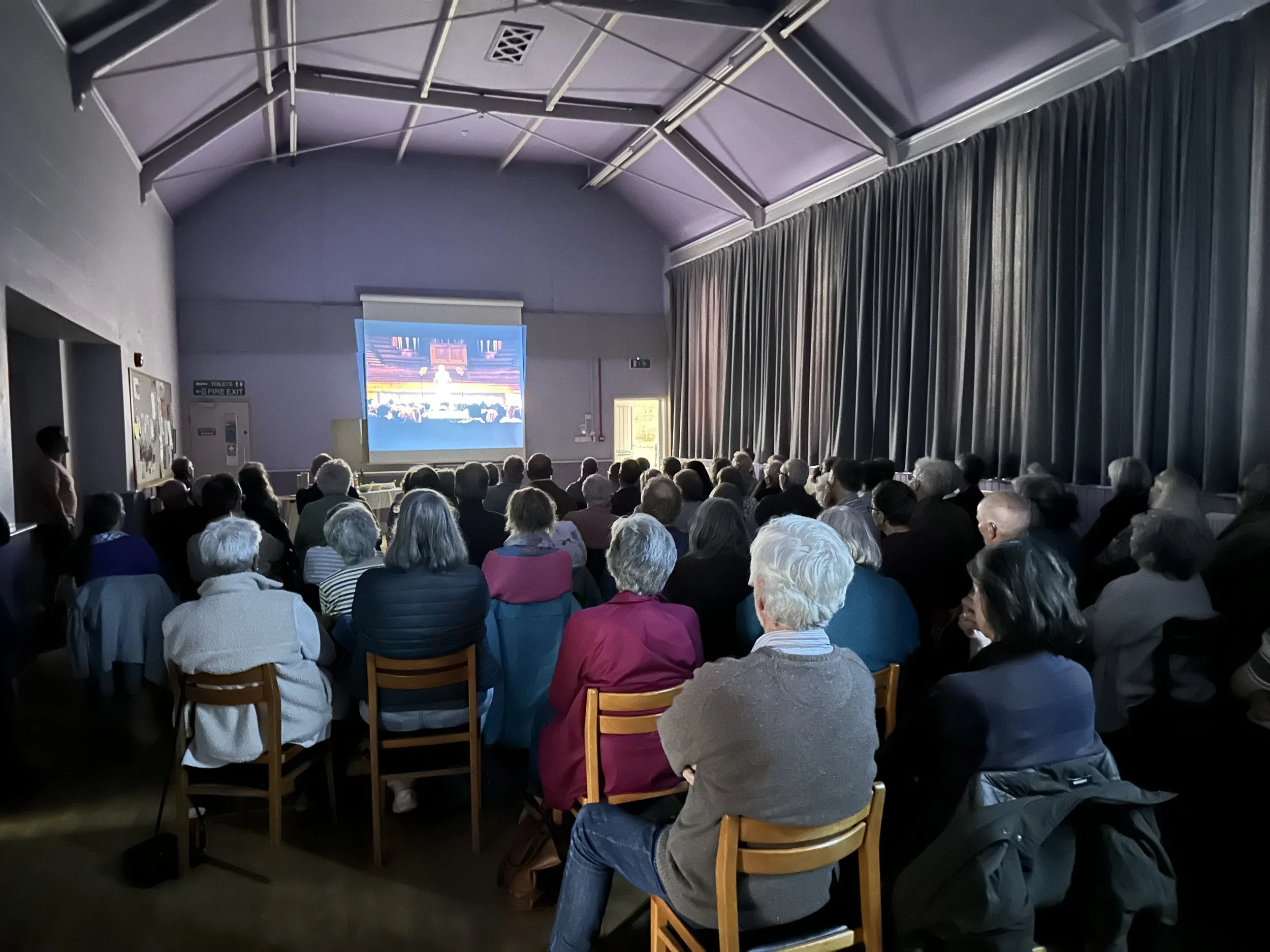
People’s Emergency Briefing, hosted by the Nailsworth Society, Sawyer Hall, 1st June 2026. Photo by: Richard Erskine.
Themes
Nine themes are included in the film. Here is a brief summary of what was covered.
Weather
Extreme weather events are happening more often like the floods in Germany in 2021 where 220 people were killed. Or the heatwave this year in the UK in May 2026. Our infrastructure is not resilient to today’s climate let alone tomorrow’s where up to 3 degrees warming (global average, and much more in local settings) is predicted. But all is not lost. Copenhagen has redesigned its centre to create a landscape that can mitigate flooding and rising waters by clever redesign of outdoor spaces and houses.
Climate
CO₂ in the atmosphere is rising at alarming rates, we are now at 1.5 degrees (global average) warming since the start of industrial revolution and there are dire prospects at 3 to 4 degrees of global warming with systemic collapse of infrastructure and food production.
The physics doesn’t care about the politics.
Tipping Points
We are underestimating the pace of change. There is a real possibility that the Atlantic Ocean could lose the warming it provides through its over-turning circulation, tipping the UK into minus 20 degrees in winter yet extremely hot in summer.
Food Security
This affects every family in the UK with failure of harvests in 1 out of every 2 years with 2 degrees of global warming. One solution is to move towards a plant based diet and to reduce food waste. At the moment 85% of land in the UK is used for animal production which is highly inefficient.
Health
The effects of climate change on the health system are profound. There could be a socio-economic collapse and food supply collapse alongside health risks from pollutants, with respiratory disease and obesity costing over 126 billion per year. A climate emergency is a health emergency.
National Security
The climate crises is fuelling instability across the world with threats from ISIS and Afghanistan due to instability. In the Arctic there is a threat from Russia wanting access to shipping routes and there are cascading crises with the prospect of ungovernable states.
Nature
The natural world is our support system and the UK is in the bottom 10% of countries in terms of biodiversity. Only 14% of rivers are in a good condition in terms of environmental health. There is a need to view nature as critical infrastructure and as one commentator put it “we can send a man to the moon but we need better solutions for our own shit”, referring to the pollution in our rivers.
Economics
The transition to a greener planet is not as expensive as we think. It’s about 4 billion a year of public funds, which is 0.2 per cent of GDP (this is supplemented by private investment that makes uo 90% of the total needed).
As the Climate Change Committee has noted, the public investment between now and 2050 is less than the cost of one fossil fuel energy shock (such as the one currently underway).
The transition so far to renewables is 73% cheaper than predicted but the losers shout the loudest with the petro chemicals and oil & gas industry still enjoying larger subsidies than renewables.
Energy Transition
Renewables offer considerable economic advantages over fossil fuels. The price of solar panels have ropped by 70% and the sun and wind are free once you’ve installed the kit. They can be installed at a large scale, in a community, or on a household roof, and this flexibility helps build flexibility and resilience into our energy system.
Local Action
There was a session after the film where we talked about what we could do, and community and household action was a key part of the discussion.
Stroud District Council (SDC) has a local action plan on climate and nature focussing on land, water and its management.
NailsworthCAN has supported local projects such a Swift project, Retrofit Fair and Our Stories, making the point on whether action is happening that It’s here, it’s now it’s us.
While Government and businesses need to do much more, about a third of the actions needed are individual, with lifestyle changes making a difference, so: Eat Green , Travel Fresh, Holday local, End clutter, Dress retro and Change the system, are key area promoted by Take The Jumpinitiative that has been championed by Cllr Maggie Dutton, Chair of NailsworthCAN, and is supported by Stroud District Council.