
Coordinated Attack on Net Zero
This week there has been a coordinated attack on net zero in papers including The Daily Mail and Telegraph. Several figures have been bandied about, as high as £7.6 trillion (£7,600 billion) as the “cost of net zero” (the graphic below is from a report by NESO, the National Energy Systems Operator, whose data these papers have shamelessly abused).
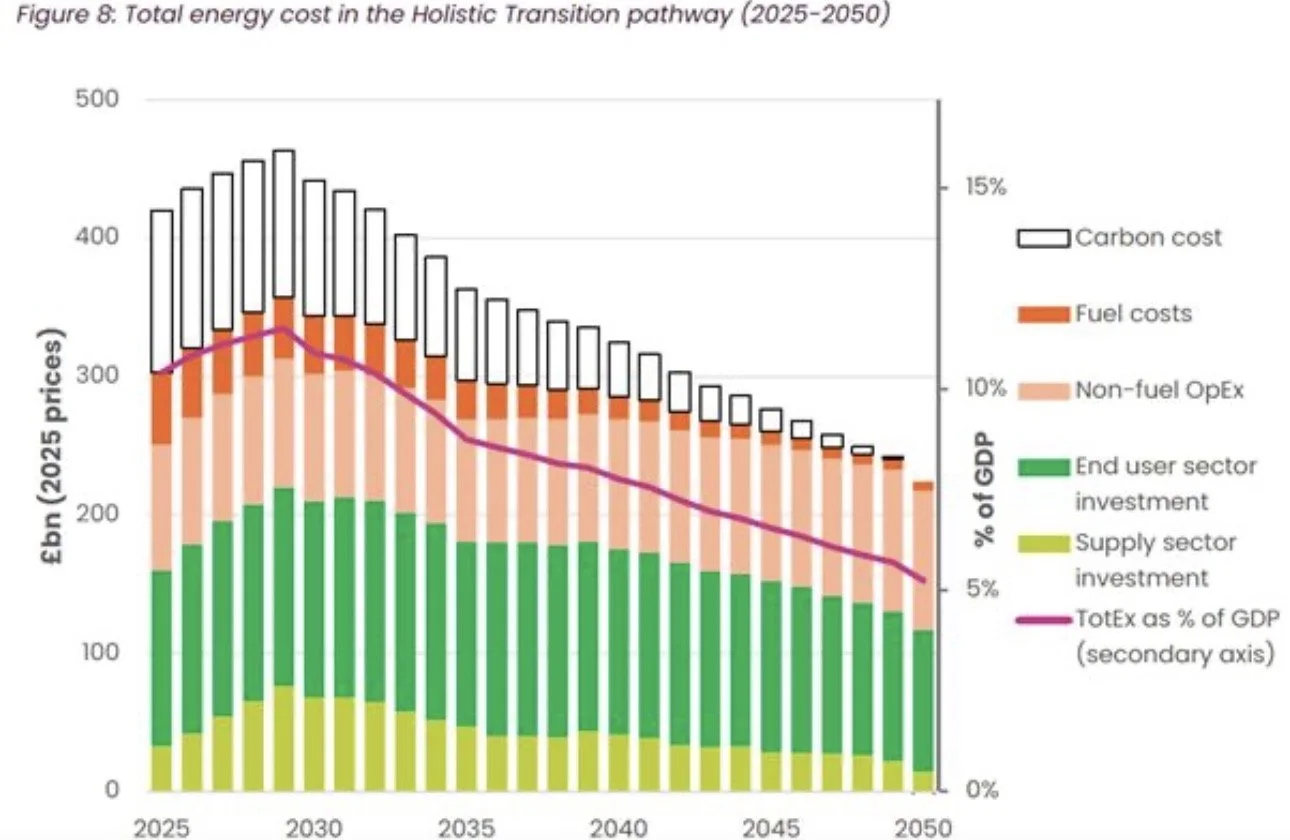
Image taken from NESO Report
Numbers like £7.6 trillion are off-the-scale false! Here's why.
The £7.6 trillion claim is deceitful because it adds up all energy spending over 25 years and pretends it’s the “cost of net zero”, ignoring that we’d have to replace power stations, cars, tractors, boilers and so on anyway.
As NESO’s chief economist Mike Thompson notes in a rebuttal on LinkedIn, that’s like saying the cost impact of choosing metallic paint for a new car is the price of the whole car with metallic paint, not the marginal difference between ordinary paint and metallic paint.
The real cost is the difference between pathways [see also Note 1].
The Climate Change Committee focuses on the costs of specific 'net zero' policy driven investments (like wind turbines), and it finds that the average annual cost will be between 1% to 2% of GDP (£30b - £60b) but with 90% of that coming from industry, so 0.1 to 0.2% of GDP annually from the public purse.
On average, that's no more than £6 billion annually from the public purse for net zero (50 times smaller than that implied by the £7.6 trillion figure) [see Note 2]
The UK spends £10b on fizzy drinks a year, is anyone really claiming we cannot afford £6b a year from the public purse to help fund a safe, secure and clean future?
What does this abstractly labelled ‘net zero’ buy us:
lower cost energy system free from fossil fuel conflicts around the world and resulting price instability;
homes and businesses no longer struggling with energy bills;
an end to burning fossil fuels in our homes and streets with all the health issues that comes with that;
warmer homes in winter and an end to fuel poverty;
a distributed, resilient and more secure energy system (with plenty of energy storage by the way);
a lot of investment in the economy to promote innovation that can be exported;
Oh, and we do our bit on climate change.
Just as Britain was a leader in the Industrial Revolution powered by coal, it can be a leader in the Green Industrial Revolution powered mostly by renewables.
Why is there this vocal, powerful minority in the UK so determined to be stuck in the past? It should not be a party political issue to embrace a completely affordable progressive future.
We need an informed debate on a just energy transition, in communities and across the political spectrum, but that is made much harder by those seeking to sow division by spreading disinformation.
That is why NailsworthCAN will call out disinformation, from whatever source it comes from, but also support those interested in respectful and informed dialogue.
Note:
[1] The analysis the Dail Mail and others have used comes from the right wing ‘think tank’ the Institute for Economic Affairs (IEA). The Grantham Institute has called out their absurd figures. See ‘Institute of Economic Affairs uses absurd assumptions to mislead the media about the costs of net zero for the UK’, 15th January 2026, https://www.lse.ac.uk/granthaminstitute/news/institute-of-economic-affairs-uses-absurd-assumptions-to-mislead-the-media-about-the-costs-of-net-zero-for-the-uk/
[2] With an economy of about £3 trillion (or £3,000 billion) in terms of GDP, the 10% the IEA uses is the whole system energy related investment and so equates to £300 billion, which when multiplied by 25 years (from 2025 to 2050) gives £7,500 billion. This is the§ scary number or thereabouts used in the papers. But the net zero cost is the marginal additional cost (the metallic paint as per the analogy above) which is no more than 2% (5 times less than 10%), which then equates to £60 billion a year. The papers imply that the public purse is on the hook for all the net zero, but the Climate Change Committee estimates that 90% of the costs will be privately funded (as has been with North Sea wind farms for example), so the public purse will need 0.2% GDP to fund net zero, or just £6 billon a year. Needless to say, £300 billion a year is 50 times greater than £6 billion a year. The IEA has shown it has no credibility suggesting such massively inflated figures as £300 billion.